
The much-awaited Cartesi sequencer takes signed user operations and confirms them right away, also known as soft confirmation in the cryptocurrency world. In the background, it posts them to L1 in batches. Users get a near-instant response, and Ethereum stays the source of truth.
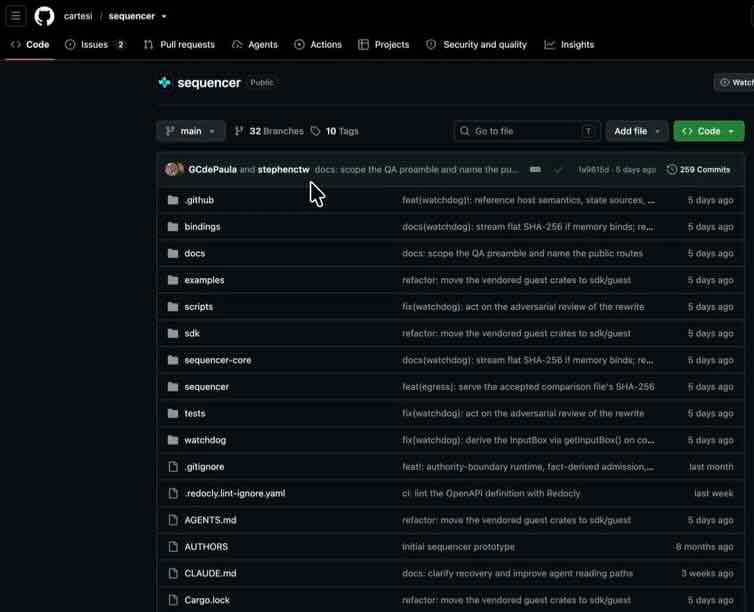
Here are features of Cartesi sequencer
Add public fee quotes, user nonce lookup, signing-domain discovery, and an OpenAPI definition.
Add versioned application history, historical replay, and checkpoint compatibility across recovery generations.
Add reusable C application bindings, a native engine host, and wallet conformance examples.
Strengthen runtime ownership, startup admission, shutdown, recovery, and snapshot publication and export checks.
Rewrite the watchdog around canonical host semantics, durable checkpoints, digest comparison, and latched divergence incidents.
Update to Cartesi Machine v0.21.0 and rollups contracts 3.0.0-alpha.10.
Each group of user ops, called a frame, points to a safe L1 block. The onchain scheduler takes in deposits up to that block, then runs the same ops in the same order. The Cartesi sequencer and the rollup follow the same rule, so both end up with the same state.
There’s a single sequencer, but it can’t steal funds or forge state. The rollup checks everything, and fraud proofs enforce the result. Deposits skip the sequencer entirely. A censoring sequencer can delay them by a few hours at most. It can never block them.
The Cartesi sequencer is still alpha, downloadable from github, but it’s progressing fast. It plans for L1 outages, crashes, reboots, long downtime, and hostile mempools. On every startup, it checks its database and Ethereum to identify what needs fixing. A separate watchdog double-checks its state.
First time on your X feed: the Cartesi sequencer! Let’s unpack what it is, why it matters, and how it works. 🧵↓ 1/ Interactive apps need speed. Ethereum settlement takes time. Nobody wants to wait minutes for L1 finality on every click. That’s where a sequencer comes in. https://t.co/K42rAwWskB
— Cartesi (@cartesiproject) October 13, 2026
The latest release, v0.1.0-alpha.10, ships the sequencer, machine images, and watchdog together.